
11 時間
Delhi to Taj Mahal & Agra Private Day Tour
- プライベート体験
- 専属サービス
- プレミアムアメニティ
- 無料キャンセル
Delhi To Taj Mahal — Day Trips, Guided Tours & Timed Entry
Leave the capital at dawn, meet marble at first light.
料金を比較して最適なものを選びましょう — すべての予約はモバイルバウチャーで、対象の場合は無料キャンセルができます。
11 時間

11 時間
11 時間
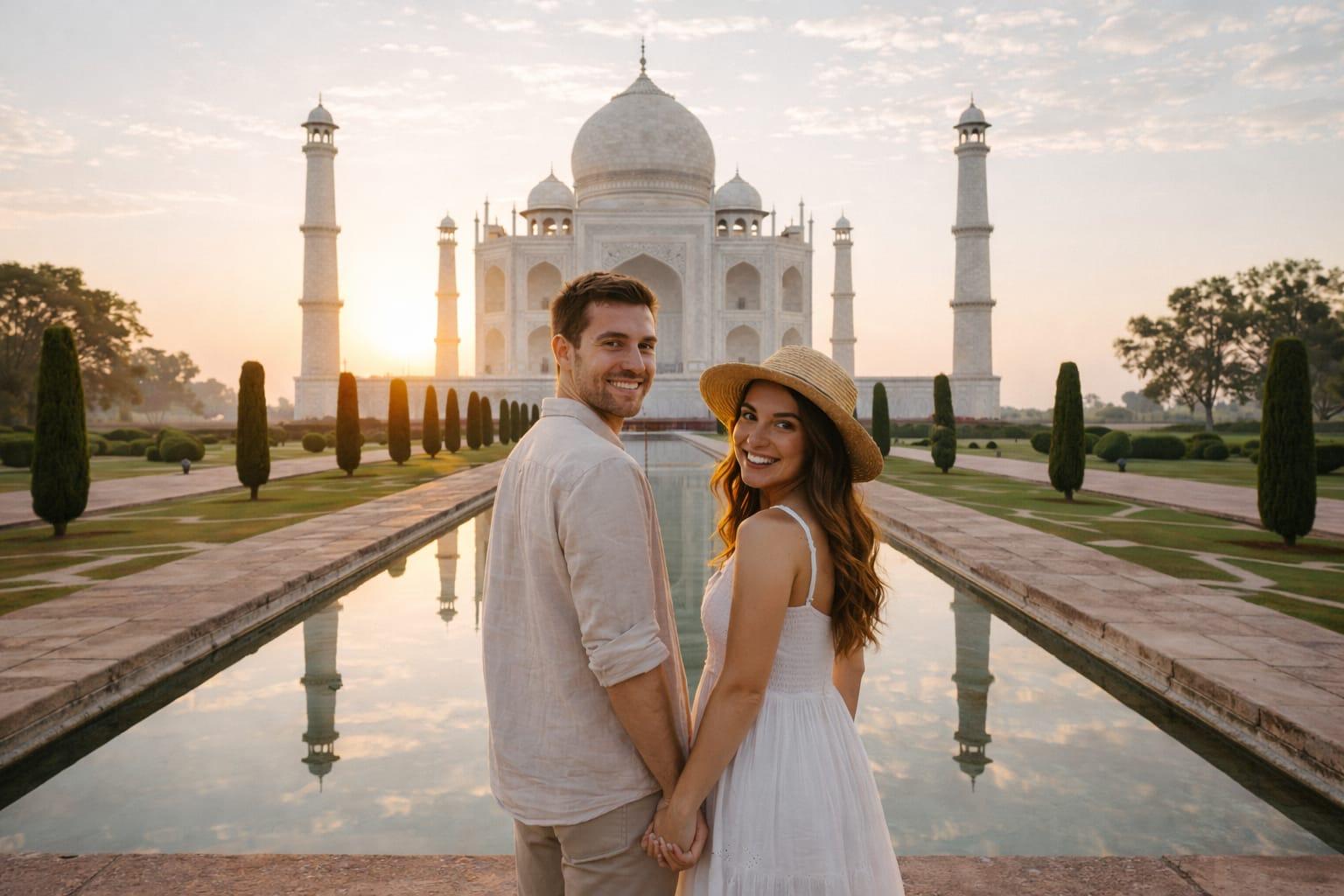
Choosing your access level is the first real decision on any delhi to taj mahal itinerary, since the monument sells three distinct tiers rather than one all-inclusive pass. The base gate ticket covers gardens and platform views, an add-on unlocks the marble mausoleum interior, and a separate limited pass offers moonlit access on select nights.
| Garden Entry Standard gate ticket |
Top pick Garden Entry + Mausoleum Base ticket plus interior add-on |
Night Viewing Limited moonlight slot | |
|---|---|---|---|
| What's included | Gardens, platform, exterior, museum | Everything in Garden Entry, plus tomb chamber | Distant platform view of illuminated exterior only |
| Interior access | — | ✓ — enter the marble tomb chamber | — (viewing only, no monument entry) |
| Extra cost | Base 1,100 INR foreign adult entry | +200 INR added to the 1,100 INR base | Separate ticket, booked apart from daytime entry |
| Who needs it | First-timers wanting gardens and iconic exterior views | Visitors who want to stand beside Shah Jahan and Mumtaz Mahal's tombs | Travelers chasing a moonlit view on a rare added evening |
| Booking method | Official site tajmahal.gov.in or gate counter | Same booking flow, select mausoleum add-on | Separate ASI counter process tied to lunar calendar dates |
| Best for | Budget-conscious first-timers | Most first-time visitors wanting the full daytime experience | Repeat visitors or moon-viewing enthusiasts with flexible dates |
| See tickets & prices |
Verdict: Most delhi to taj mahal tour first-timers should add the 200 INR mausoleum access to their base entry, saving the separate night-viewing ticket for a later trip timed to the lunar calendar.
Worth it for nearly every first-time visitor
The delhi to taj mahal run costs foreign adults 1,100 INR at the gate, plus an optional 200 INR to step inside the mausoleum chamber. For that, you get the full walled complex: the charbagh gardens, the central reflecting pool, unobstructed exterior views of the white-marble monument, the on-site museum, and the darshan-style approach through the great gate. Even without the extra 200 INR, the exterior and grounds carry the visit. Weighed against most world-heritage sites, that fee is fair value for a UNESCO landmark of this scale. Well-run delhi to taj mahal tours fold the entry into a single day-trip price, which suits travellers short on time. Independent visitors clutching their own tickets keep costs lower but shoulder the logistics. It pays off for first-timers, architecture lovers, and photographers; it underwhelms only those expecting a quick, crowd-free stop.
Bottom line: For most travellers, a delhi to taj mahal tour returns clear value on its modest entrance fee.
数千人の旅行者に愛される厳選された体験
5 hours – 1 day (approx. 13 hours door-to-door)
無料キャンセル
Ride India's fastest train from Delhi to explore the Taj Mahal, Agra Fort & Baby Taj in one seamless day.
5–11 hours
無料キャンセル
Ride in an Audi, BMW or Mercedes to the Taj Mahal and Agra Fort with a private guide and 5-star dining.
5–11 hours
無料キャンセル
Chase the dawn at the Taj Mahal on a private guided journey from Delhi covering Agra's greatest Mughal monuments.
Pass security screening and enter the forecourt gardens leading to the Great Gate
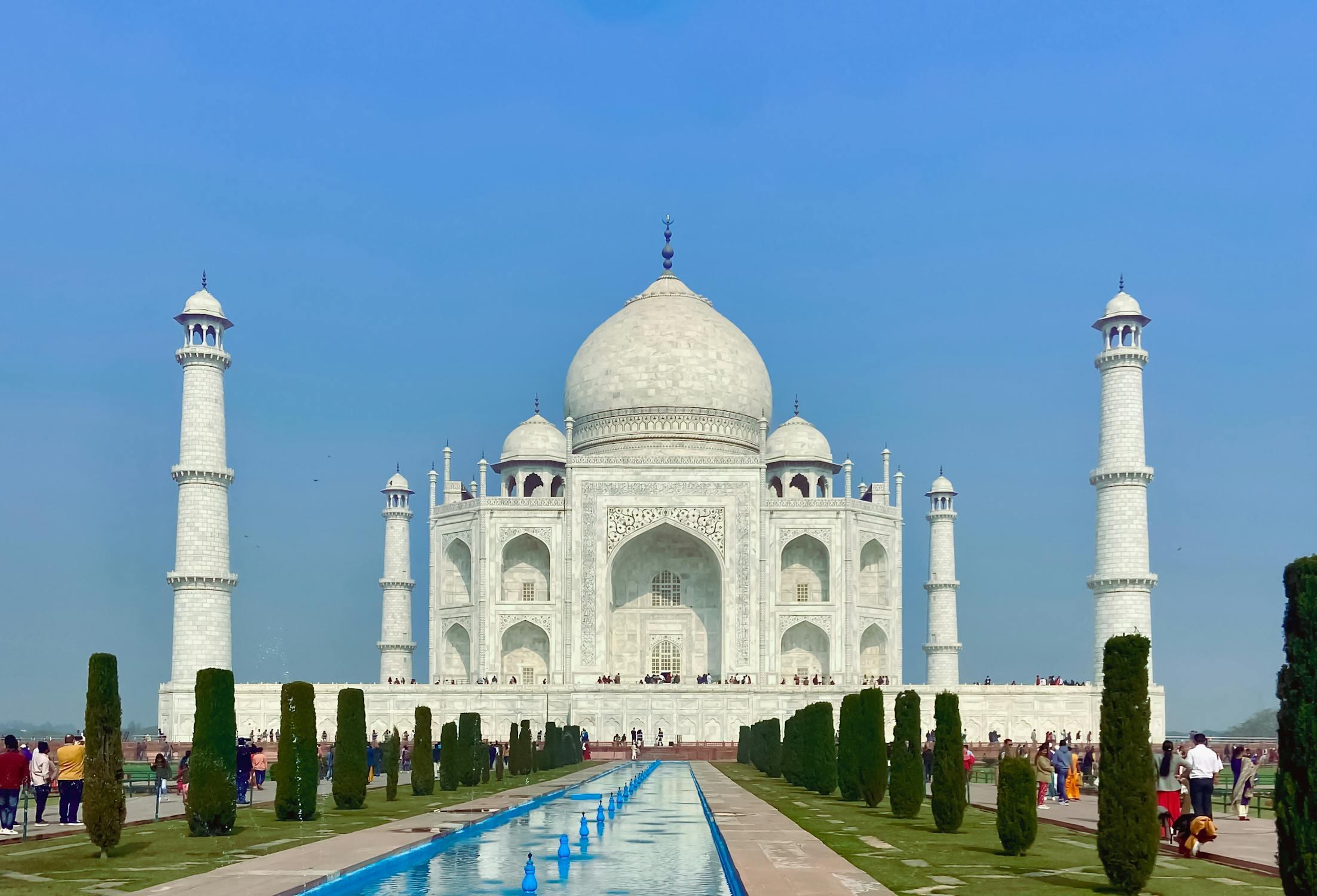
The central white marble dome rises to roughly 35 meters with a finial reaching about 42 meters, and houses the cenotaphs of Shah Jahan and Mumtaz Mahal above their actual crypt below. Its bulbous shape is often cited as one of the largest asymmetrical domes among Mughal-era structures.
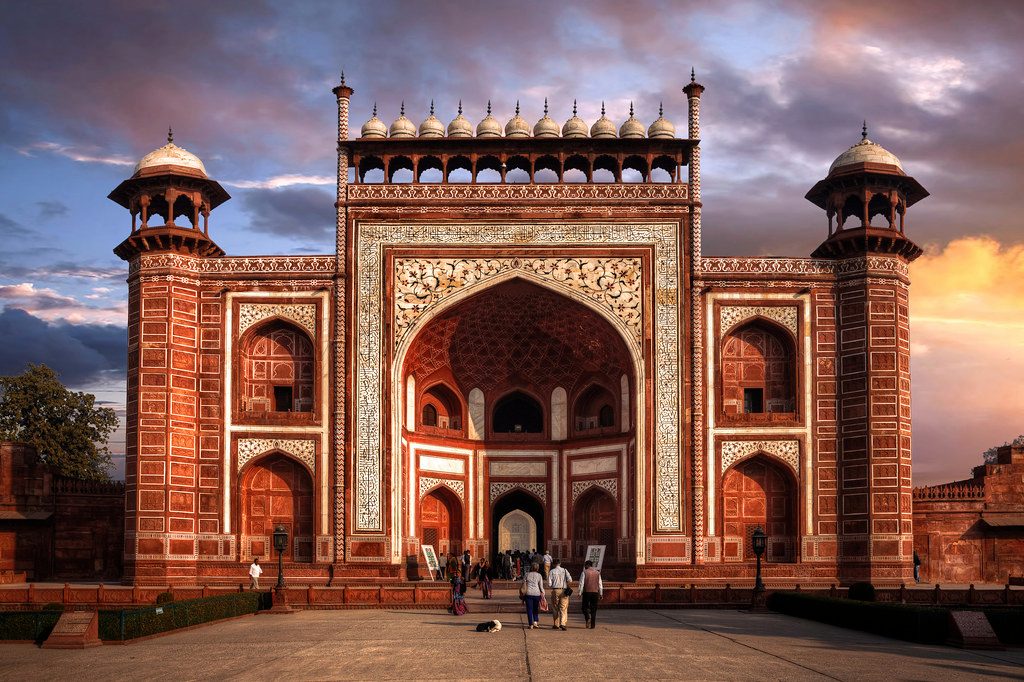
You set out from the capital in the dark, and by the time the expressway gives way to Agra's outskirts the sky has turned the colour of ash. You reach the eastern gate within the recommended 06:00–08:00 window, when the air is still cool and the light stays soft. You pass through security, surrender the last of your snacks, and step into the forecourt. Then the great red sandstone gateway frames it: the dome, small and impossibly white through the arch. You walk toward the reflecting pool, where the marble doubles itself in still water. You pause on the central bench, the same spot where thousands before you have stopped without deciding to. You climb the plinth barefoot or in provided shoe covers, and the stone is cold underfoot. You trace the inlaid flowers with your eyes, run a hand near the calligraphy, and circle the tomb chamber where the cenotaphs sit behind a carved marble screen. Any well-planned delhi to taj mahal day trip lingers here longest. You drift to the western mosque for shade, watch the river curve behind the monument, and leave before the mid-morning crowds arrive — the marble already warming under a rising sun.
次の冒険のすべての詳細が一箇所に
The delhi to taj mahal route covers roughly 230 kilometers along the Yamuna Expressway, connecting the capital with Shah Jahan's ivory-white marble mausoleum in Agra. Our delhi to taj mahal tours pair air-conditioned transfers with a knowledgeable guide who brings the UNESCO World Heritage monument and its riverside setting to life. Travelers reach one of India's foremost landmarks without the logistics of arranging separate transport and entry.
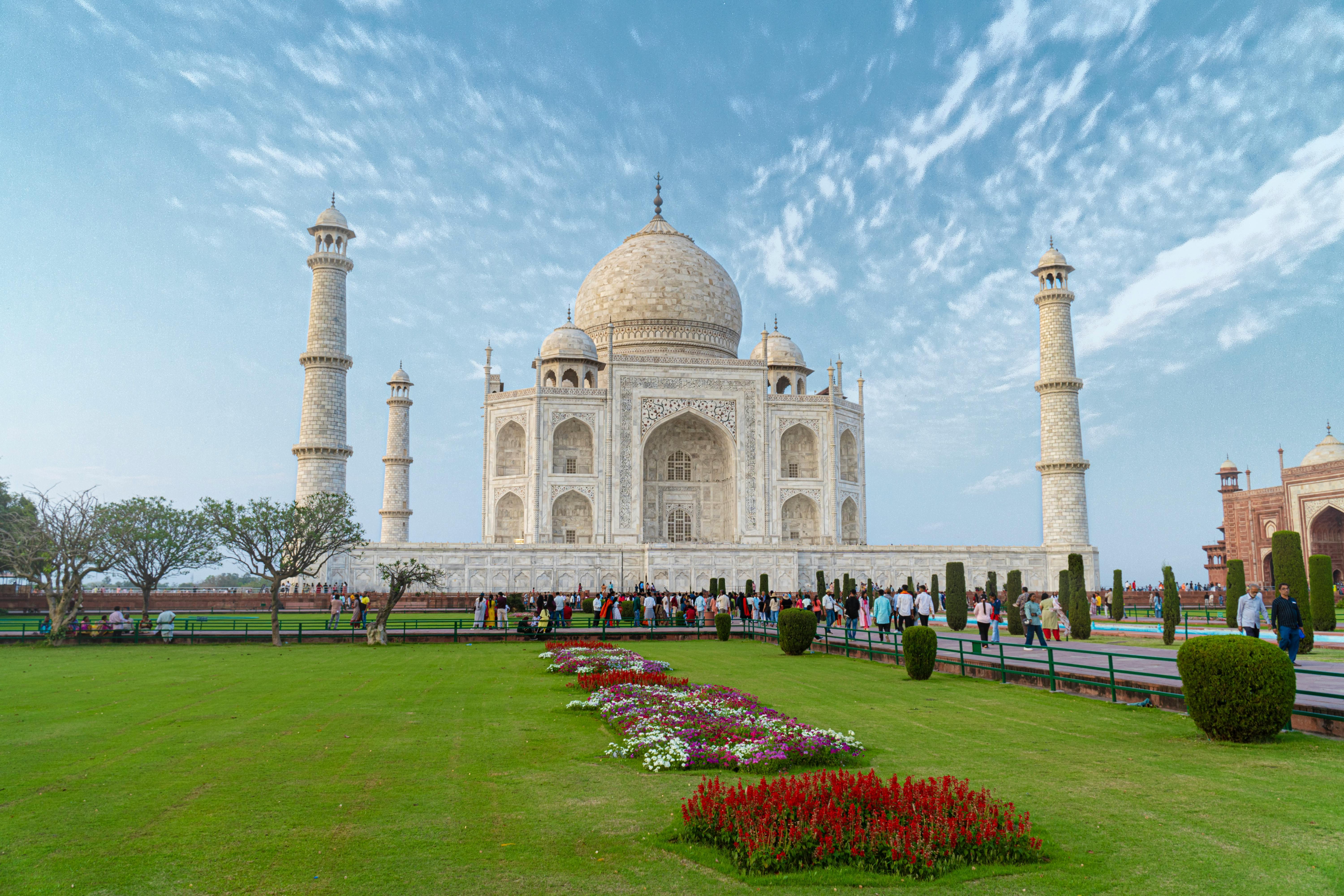
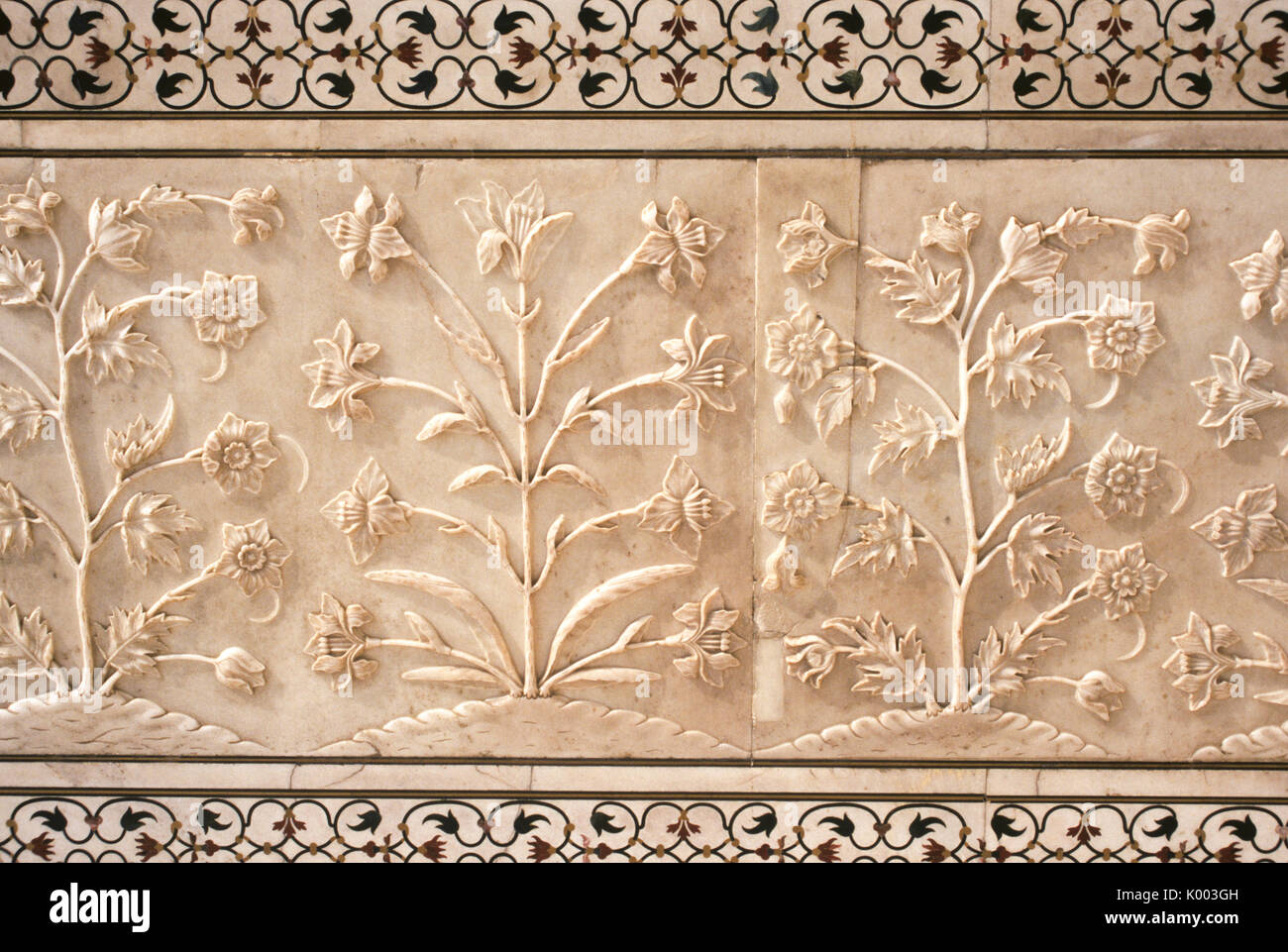
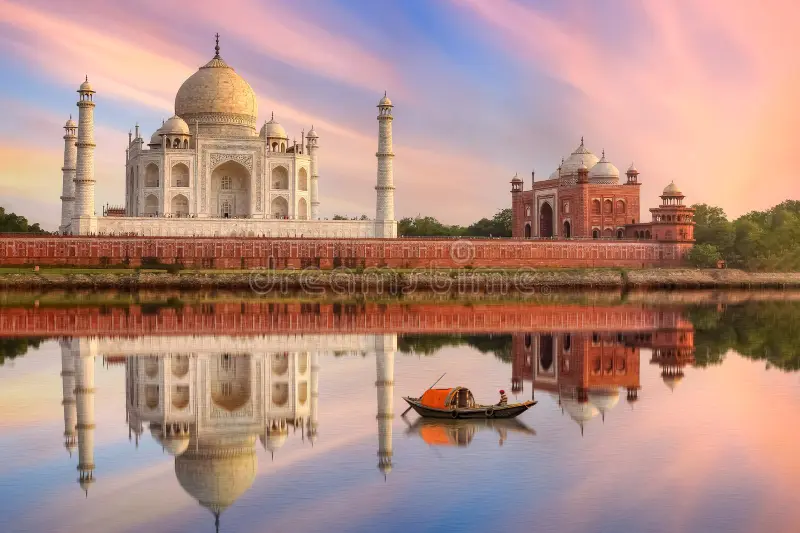
The white marble of the Taj Mahal is not merely quarried stone but a semi-translucent variety from Makrana, roughly 400 kilometres away, hauled by a reported 1,000 elephants across the plains of Rajasthan. Commissioned by the Mughal emperor Shah Jahan in memory of his wife Mumtaz Mahal, the mausoleum crowns the south bank of the Yamuna at Agra, a city that once served as the Mughal capital before the court shifted to the fortified lanes of the capital region to the north. For the modern traveller, the delhi to taj mahal corridor traces almost the same axis that imperial processions once followed, threading through the Gangetic plain toward Agra's sandstone gateways. The complex is a study in symmetry. A raised marble plinth carries the domed tomb, flanked by four tapering minarets, each leaning almost imperceptibly outward so that any collapse would fall away from the central chamber. On either side stand mirror-image buildings in red sandstone — a mosque to the west and its architectural echo, the jawab, to the east — framing a formal charbagh garden divided by water channels into quadrants. Inlaid across the facades, a technique called pietra dura sets semi-precious stones into the marble: carnelian, jasper, lapis lazuli and turquoise arranged as blossoms and Quranic calligraphy that subtly enlarges as it rises, correcting for the viewer's angle far below. Designated a UNESCO World Heritage Site in 1983, the monument today anchors the wider circuit of Agra landmarks alongside Agra Fort and the abandoned city of Fatehpur Sikri. Its significance is not only architectural. The Taj represents the apex of Indo-Islamic craftsmanship, fusing Persian, Ottoman and indigenous traditions into a single coherent vision that took some twenty years and tens of thousands of artisans to complete around 1653. Conservation now shapes daily life at the site, from restrictions on nearby industry to the periodic mud-pack facials applied to draw pollutants from the marble. Seen from the reflecting pool, the dome appears to change colour through the day — pale rose at dawn, brilliant white at noon, and amber under a low sun. This shifting palette is precisely why so many travellers choose an early delhi to taj mahal tour, timing their approach to the Yamuna before the summer haze thickens. The journey has become one of the most travelled cultural routes in the subcontinent, and well-organised delhi to taj mahal tours continue to draw visitors who want the monument framed by history rather than logistics alone.
Any collapse of the minarets would fall away from the tomb, not toward it — symmetry engineered for eternity.
There is no strict enforced dress code for foreign visitors at the Taj Mahal, but modest clothing covering shoulders and knees is recommended given the site's religious mosque wing. Cloth shoe-covers are provided free at the mausoleum's marble platform to protect the stone, and comfortable walking shoes are practical for the marble plinth and gardens.
Airport-style security screening with metal detectors and pat-downs takes place at both the Western and Eastern Gates before entry to the Taj Mahal complex. Only small handbags are permitted; large backpacks, tripods, and power banks over a certain capacity are typically turned away or require a cloakroom deposit.
Personal still cameras and phones are allowed throughout the Taj Mahal gardens and exterior, but photography is prohibited inside the main mausoleum chamber housing the cenotaphs. Tripods, drones, and professional video equipment require separate permission from the Archaeological Survey of India and are not permitted for casual visitors.
Children under 15 enter the Taj Mahal free of charge, making it straightforward for families to combine sightseeing without extra ticket cost for younger kids. The marble platform around the mausoleum can be slippery when wet and lacks continuous railings, so parents should keep young children close, especially near the riverside terrace.
Wheelchairs are available free of charge at the entry gates, and ramps connect the forecourt to the raised marble platform in front of the mausoleum. The final approach and steps up to the mausoleum plinth are uneven marble, so visitors with mobility limitations should request gate staff assistance in advance.
Food and drink are not permitted inside the Taj Mahal complex; visitors are asked to finish snacks and meals before passing through security at the gates. Sealed drinking water in small bottles is generally allowed through the checkpoints given Agra's heat, but no eating is permitted once inside the gardens or near the mausoleum.
Cooler mornings draw early crowds
Quieter before Friday closure
Closed for prayers, no tourist entry
Busiest day of the week
Family groups common
Hours today
06:00–18:30 (closed Fridays);location
Public transport · 1h 40m · Train fare varies by class, booked via IRCTC;Car
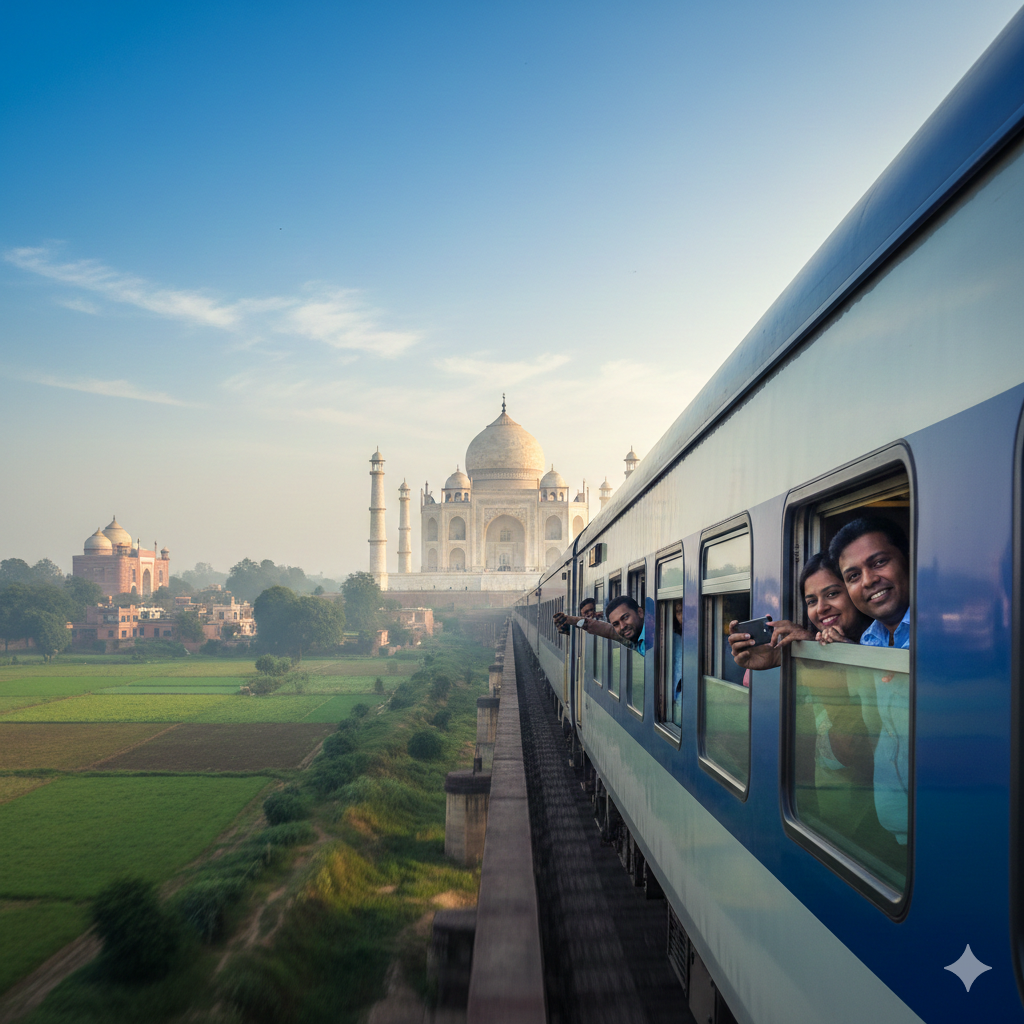
Gatimaan Express departs Hazrat Nizamuddin Railway Station around 08:10 and reaches Agra Cantt in about 1 hour 40 minutes, making it the fastest rail option for a same-day trip.
Entrance tickets booked online for the Taj Mahal are generally non-refundable and non-transferable once issued, including the 1,100 INR foreign adult entry fee and the optional INR200 mausoleum add-on. Date or slot changes are not guaranteed and depend on availability at the ticket counter or booking portal on the day of the visit.
Recommended time
2.5-3 hours
Budget 2.5 to 3 hours for a thorough delhi to taj mahal visit that covers the gardens, the main platform, and the mausoleum interior without feeling hurried; an hour is enough only if you're skipping the mausoleum and sticking to the classic photo walk. Arrive during the 06:00-08:00 window, right at opening, since queues at the ticket counters and security checkpoints are shortest then and the marble sits in softer light. Crowds build steadily from mid-morning and peak between roughly 10:00 and 13:00 as coach tours and day-trippers from Agra and Delhi Taj Mahal tours arrive together, so add extra buffer time to your plan if you're entering after 09:30. Anyone booking delhi to taj mahal tickets in advance still faces the same rhythm, so timing your entry matters more than the ticket type.
Crowd levels through the day
天候・混雑・平均価格 — 各指標が上昇するにつれて点が緑から黄色、赤へと変わります。
Cool days around 10-25°C make this the peak season for a delhi to taj mahal trip, with the clearest skies for photography but the heaviest crowds around Christmas and New Year.
Reserve entry tickets through the official portal before travel to skip counter queues at the Western or Eastern Gate, especially in winter.;Carry ID and printed ticket
Near Saheli Burj, Tajganj, Agra
Main entry point for most tour groups and taxis
Get directionsThe story begins in grief. In June 1631, Mumtaz Mahal died in Burhanpur while delivering her fourteenth child. Her husband, the Mughal emperor Shah Jahan, resolved to raise a mausoleum worthy of her memory. Construction of the marble tomb commenced in 1632 on the right bank of the Yamuna at Agra. The main structure was largely complete by 1643. Ancillary buildings, gardens, and the surrounding complex continued until roughly 1653. Those who travel the delhi to taj mahal route today walk toward a monument that consumed more than two decades of labour. The project drew on a vast pool of talent. Ustad Ahmad Lahauri is generally credited as chief architect, coordinating a workforce estimated at around 20,000 artisans, masons, and labourers. White marble arrived from Makrana in Rajasthan. Semi-precious stones for the pietra dura inlay came from across Asia. A charbagh garden, divided by watercourses, framed the tomb along a strict axis. The riverfront setting and the reflecting pool were deliberate compositional choices, not decoration. Skilled calligraphers rendered Quranic verses in inlaid black stone across the great gateway. Many who book delhi to taj mahal tours arrive knowing little of this coordinated Mughal enterprise. History did not leave the monument untouched. In 1658, Shah Jahan was deposed by his son Aurangzeb and confined at Agra Fort, from where he could view his wife's tomb until his death in 1666. He was later interred beside Mumtaz Mahal, the only asymmetrical element in an otherwise balanced design. By the nineteenth century the complex had suffered neglect, and Lord Curzon ordered restoration work around 1900. A delhi to taj mahal tour now traces both the building and its long survival. Recognition came in 1983, when UNESCO inscribed the site as a World Heritage monument. Modern threats followed: pollution discoloured the marble, prompting a protective zone around Agra. Those securing delhi to taj mahal tickets today enter a landscape shaped by conservation science as much as by seventeenth-century ambition. Among Agra landmarks, this remains the defining Mughal achievement. The verified official portal is https://www.tajmahal.gov.in, and the monument stands closed each Friday for prayers.
Mumtaz Mahal died in childbirth at Burhanpur, prompting Shah Jahan's commission.
Construction of the marble mausoleum began on the Yamuna's bank at Agra.
The principal tomb structure reached substantial completion.
The wider complex, gardens, and outbuildings were finished.
Aurangzeb deposed Shah Jahan and confined him at Agra Fort.
Shah Jahan died and was buried beside Mumtaz Mahal.
UNESCO inscribed the monument as a World Heritage Site.
Also called the VIP Bench, this low marble seat sits on the raised platform in front of the reflecting pool and is the classic sit-and-pose shot with the mausoleum framed behind. It's a magnet for queues, and the walking route from Delhi to Taj Mahal typically ends here for the first group photo of the day.
Stand at the platform's centerline behind the long water channel so the marble facade and its four minarets mirror perfectly on the surface. Keep the camera low, near water level, to maximize the reflection.
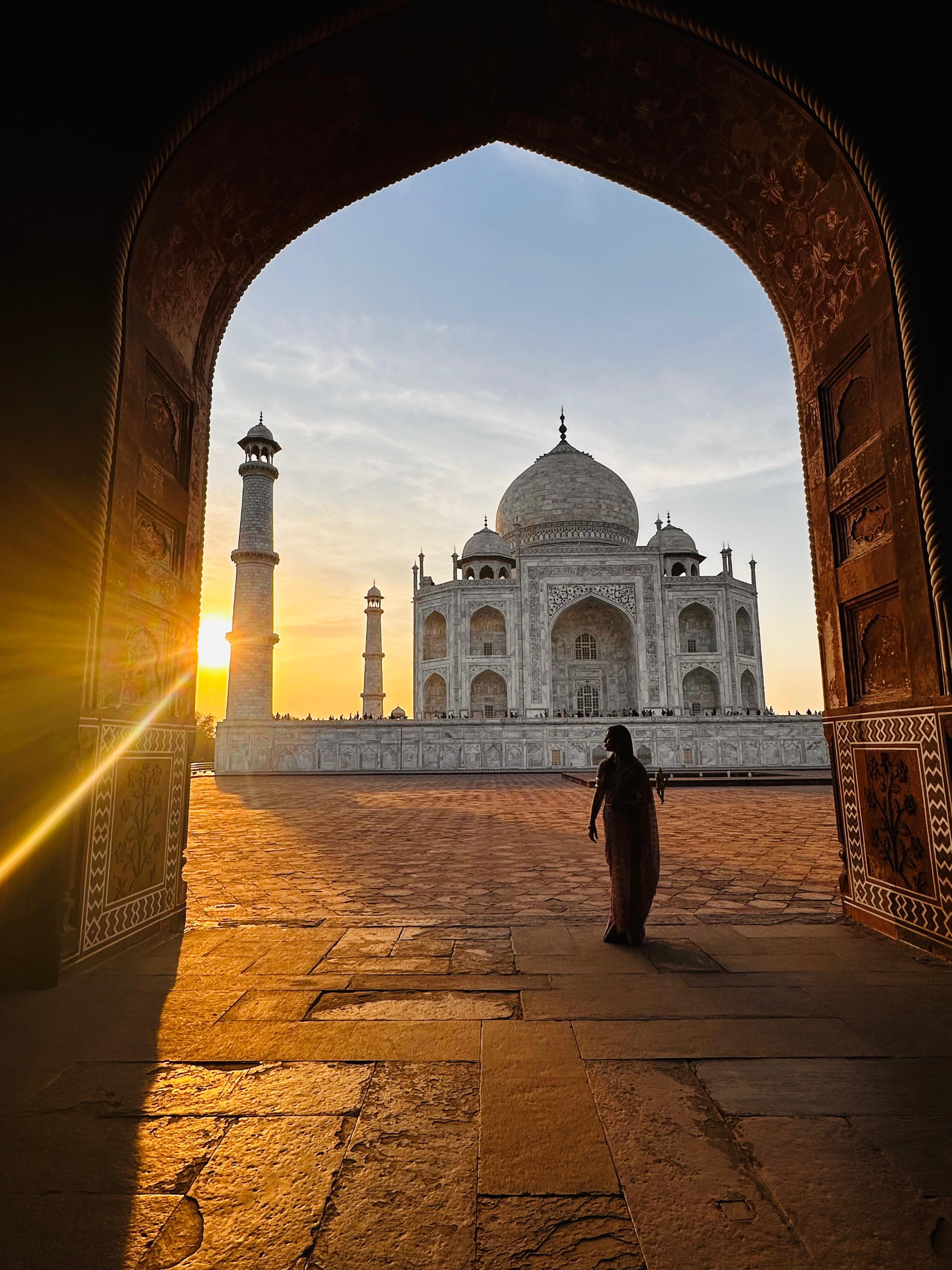
From inside the red sandstone gateway, the pointed archway frames the mausoleum like a picture window, a favorite before-and-after shot as visitors pass from the forecourt into the gardens.
The red sandstone mosque flanking the mausoleum's west side has a repeating arcade of arches that lines up in perspective, giving a strong leading-line shot toward the dome.
Across the Yamuna River, this Mughal garden faces the monument's rear facade and delivers the classic cross-river silhouette with the marble reflecting the sunset's color shift.
The tree-lined path leading up from the ticket area gives a rising, symmetrical view of the dome appearing gradually, a spot many delhi to taj mahal day-trippers use for their first full-monument shot before joining the crowd near the platform.
There is no dining inside the monument itself, so most visitors on a delhi to taj mahal day trip walk out through the East or West Gate and eat in Tajganj, the small district that fronts the walls, where rooftop cafes and Mughlai kitchens sit within a few minutes on foot.
On Fatehabad Road, it mixes North Indian, Mughlai, and Chinese dishes, with tandoori kebabs and biryani among the regulars' picks. It gets busy around lunchtime with tour groups fresh from the gates, so an early or late sitting is calmer.
A short walk from the walls, this rooftop mixes Indian street snacks with Continental plates and looks straight at the domes. Sunset is the busiest stretch, so arrive ahead of that for a table.
Run by acid attack survivors near the East Gate, it serves burgers, pasta, shakes, and Indian staples on a pay-as-you-feel basis. Good for a relaxed, unhurried stop rather than a quick bite.
Inside the Oberoi Amarvilas, this candlelit tandoor room serves Mughal court-style kebabs and biryani with live santoor music. Reservations for the evening seatings are worth locking in ahead, especially if pairing dinner with a delhi to taj mahal tour that ends near sunset.
実際の旅行者のリアルな体験
We booked one of the delhi to taj mahal tours that left at 6am and the expressway was empty, so we reached Agra in under four hours. Arriving before the midday heat meant the marble still had that cool pink tint from the sunrise. Our driver knew exactly where to drop us for the shortest walk to the west gate.
The whole delhi to taj mahal drive was worth it just to see the dome shift from grey to gold as the sun came up over the Yamuna. The pietra dura inlay up close is finer than any photo suggests. Bring sunglasses because the white marble throws back a lot of light by mid-morning.
Did the Agra Taj Mahal tour as a single long day and never felt rushed. The gateway arch framing the dome is the shot everyone wants and the guide pointed out the optical trick where the minarets lean slightly outward. Humid July morning but manageable if you go early.
The delhi to taj mahal tickets were bundled with our transport which saved a lot of queuing hassle. The road stretch is monotonous farmland for a while, so download something for the ride. Once inside, the symmetry of the Mughal gardens and the calligraphy around the arches made the trek worthwhile.
Our guide added a stop across the river at sunset which gave a completely different angle of the Taj mirrored in the water. The delhi to taj mahal tour covered the mausoleum, the mosque on the west side, and that riverside viewpoint. Comfortable van and cold water bottles the whole way.
Booked the skip-the-line Taj Mahal option and walked past a queue that must have been an hour long. The dome catches the light differently every fifteen minutes so we lingered near the reflecting pool. Cool February morning made the walking easy.
We left Delhi in thick December fog which delayed the start of our delhi to taj mahal journey by about an hour, but it lifted by the time we reached Agra. The white marble against a clear blue winter sky was sharp and bright. Wear layers because early mornings are genuinely cold that time of year.
One of the better Delhi landmarks day trips I've done, and the Taj itself needs no exaggeration. Standing under the central dome you can hear the echo when someone hums. The inlaid flowers on the cenotaph screen are astonishingly delicate.
The delhi to taj mahal tickets came with a knowledgeable local guide who explained the Persian and Indian influences in the design. Monsoon-season clouds actually made the marble look softer and less blinding. The Yamuna was fuller than I expected behind the mausoleum.
Went in peak summer and the heat off the marble courtyard by noon was intense, so an early start is essential. The Agra Taj Mahal tour we picked had a good driver and a clean vehicle. Carry water and go straight for the main viewpoint before the crowds thicken.
旅に必要なすべての情報
The Taj Mahal is open 06:00 to 18:30 every day except Friday, so most delhi to taj mahal tours are scheduled for early morning entry within that window.
No, the monument is closed to general tourists every Friday for prayers, though it is open 06:00 to 18:30 on all other days of the week.
Foreign adult entry costs 1,100 INR, with an optional additional INR200 to access the main mausoleum chamber.
Options include the Gatimaan Express train from Hazrat Nizamuddin Station in about 1 hour 40 minutes, or a private car via the Yamuna Expressway taking roughly 3.5 to 4 hours; both are common for a delhi to taj mahal day trip.
Online entrance tickets for the Taj Mahal are generally non-refundable once issued, so check your booking provider's specific terms before confirming a delhi to taj mahal tour.
Small bags and personal cameras are allowed, but tripods, drones, and professional video equipment are restricted, and all visitors pass through metal-detector security at the gates.
There's no strict dress code, though modest clothing covering shoulders and knees is recommended, and shoe-covers are provided free at the marble platform.
Yes, free wheelchairs are available at the gates and ramps connect to the raised platform in front of the mausoleum, though the marble surface itself is uneven.
Yes, children under 15 enter free, making family travel straightforward for a delhi to taj mahal tour.
No, food and drink other than sealed water bottles are not permitted past security checkpoints into the gardens or mausoleum area.
Winter months from November to February offer the coolest weather for delhi to taj mahal tickets and sightseeing, while summer requires an early 06:00-08:00 arrival to avoid extreme heat.
Agra Fort, Mehtab Bagh, and Itimad-ud-Daulah (the Baby Taj) are all within a 15-minute drive and combine well with a skip-the-line Taj Mahal visit.
A red sandstone Mughal fortress on the Yamuna River offering a distant view of the Taj Mahal's dome across the water. It was the primary residence of Mughal emperors before Shah Jahan was imprisoned here by his son.
The neighborhood directly surrounding the Taj Mahal's south gate, packed with budget guesthouses and rooftop restaurants facing the monument.